Fork Lift Trucks - Guide to Safe Use
Dear Reader
During their recent National Fork Lift Safety Week held in September the Fork Lift Truck Association announced shocking figures to demonstrate the high level of risk associated with fork lift truck operation. They believe the provision of proper, accredited training to be the single most significant action any employer can take to safeguard their employees, the public and their businesses.
As a training provider we promote the importance of training in all our newsletters, but in the case of fork lift truck operation training really is the best way to save lives. In this newsletter we look at your obligations and provide some basic safety information as well as details of the training required and what it should include.
I would also like to take this opportunity to wish you all a very Merry Christmas and Happy New Year and thank you for your interest in our newsletter and training courses over the last 12 months.
Safe Operation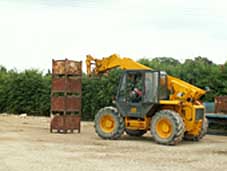 The Health and Safety Executive (HSE) has highlighted fork lift truck safety as a particular area of concern, estimating that on average fork lift trucks are accountable for 24% of all workplace transport accidents. The Health and Safety Executive (HSE) has highlighted fork lift truck safety as a particular area of concern, estimating that on average fork lift trucks are accountable for 24% of all workplace transport accidents.
Developed in the 1920's fork lift trucks are now a common and indispensable piece of rural machinery. The most commonly used fork lift in the rural sector is the rough terrain type. Whilst significantly more stable than most other trucks, the types of work rough terrain vehicles are designed to carry out come with many inherent risks. Most accidents can be avoided by following some very basic safety rules:
Many accidents happen due to poorly laid out farms and estates. Always ensure a full risk assessment is carried out prior to any use, including the removal of debris, evaluation of surface condition, lighting, ventilation and safety barriers etc.
Always ensure the vehicle is maintained to a high standard and checked before each and every use
-
Always wear seat restraints
-
Ensure the type of truck used is fit for purpose
-
Ensure adequate supervision at all times. A lone operator accident in a field can go unnoticed for many hours, during which time the severity of injury will escalate.
-
Never speed or overload the truck
-
Keep well clear of pedestrians and other potential hazards
-
Take particular care in loading bays
-
Minimise the need for reversing and use on ramps/gradients
The Skills Centre has recently produced a short instructional video to demonstrate some of the skills required to operate a fork lift truck safely. Please click here to view.
However, there is no doubt that most fork lift truck accidents are due to lack of training, therefore the best way to ensure safe operation is via the provision of training by an accredited supplier. Furthermore, your employees should be given regular refresher training, a minimum of every 3 years.
|
Training
In order to comply with your duties under the Provision & Use of Work Equipment Regulations 1998 (PUWER), you must ensure that all fork lift operators are provided with adequate training.
The HSE has published an Approved Code of Practice (ACOP) which sets the minimum standard of training your employees should receive before they can be permitted to operate any type of fork lift truck. It also provides detailed guidance on how to meet your obligations. Please click here for more information.
- The ACOP sets out three stages of training:
- Basic skills and knowledge for safe operation
- Specific job training
- Familiarisation / refresher training
Under the ACOP guidelines only 6 organisations are recognised as accredited providers of fork lift training. LANTRA Awards is one of these organisations. LANTRA courses cover everything required to meet the minimum standards including:
- Maintenance
- Mounting and dismounting
- Use of controls and instruments
- Starts, move off, acceleration, breaking, stopping and parking
- Stability, load centres
- Position, turning and straightening
- Rear end swing
- Use of lift / tilt
- Fork position
- Driving with pallets
- Stacking / destacking
Here at Rural Skills we offer a range of LANTRA fork lift course including:
- Fork Lift Industrial(Class 1): This day course, designed for experienced operators, covers the theory update, driver refreshment, training and assessment for lift truck operators
- Fork Lift Rough Terrain Telescopic (Conversion and Corrective): A great course for experienced operators with formal training on one class of truck who require training on a different class type. This course can also be taken by operators wishing to brush up their safety and driving techniques
- Fork Lift Rough Terrain Telescopic (Experienced): This 2 day course covers the theory, update driver refreshment training and assessment for lift truck operators
For more information and details of course dates for 2012 please contact us on 01285 889873. |
|
Upcoming Course Information
Course availability for December and January:-
- Dry Stone Walling: Introduction – 10th December
- Granule Application PA4S – 14th December
- Pest Control: Rabbits and Moles – 16th December
- Hedge Laying – 7th January
- NPTC CS30/CS31 Chainsaw, Maintenance, Operation, Cross Cutting and Felling of Small Trees – week commencing 9th January
- Emergency First Aid – 11th January
- NPTC CS38 Tree Climbing and Aerial Rescue – week commencing 16th January
- Ground Crop Sprayer PA2A – 17th January
- NPTC CS39 Use of a Chainsaw with a rope and harness – 23rd & 24th January
- Safe use of Pesticides PA1 – 25th January
- Introduction to Tractors – 26th & 27th January
|