May 2007 |
|
Dear David Last month we discussed the importance of setting up accounting systems early in the process of starting up your new business. There’s another decision to be made early on, so this issue of Six Degrees asks what structure should you choose to best meet your needs and those of your business in these early stages? Please feel free to forward this issue to anyone else you think will enjoy reading it and tell them they can subscribe to receive their own free monthly copy by clicking here. With best wishes, The CMC Partnership What Business Structure Do You Choose?There are three basic choices, each of which has advantages and disadvantages. Sole Trader is the simplest structure. It is well suited to businesses, where most of the value in the business is in the expertise or information you supply. Being a sole trader leaves you most exposed if something goes wrong, so you should only choose to be a sole trader if you do not have large amounts of money tied up in the business. As a Sole Trader, you are self-employed, which means that:
This structure is generally not suitable if you want to raise capital – something we will discuss in more detail in next month’s issue. Partnerships share the responsibilities and risks of ownership, by allowing you to set up in business with one or more other people. Taking on partners reduces the burden and provides you with cover when you're sick or away. Like a sole trader, a partnership does not have a separate legal identity, so does not have to be registered at Companies House, and you are regarded as self-employed. Partnerships have unlimited liability for the firm's debts. As a Partner in England, Wales and Northern Ireland, you are jointly liable, with your fellow Partners, for debts owed by the partnership, meaning you have equal responsibility for payment of the whole debt. However, you are not severally liable, which makes each of you responsible for the entire debt. In Scotland, partners are both jointly and severally liable. It is also possible to set up as a limited partnership or limited liability partnership, both of which reduce your and your partners’ individual risk. There is also a limited liability partnership (an LLP) which we will look at in another issue of Six Degrees. Companies allow you to raise capital, issue shares and limit your risks. There are more regulations governing the way they are run, and you must register the company at Companies House. Directors of Companies are treated as employees for tax and PAYE. You might choose to set up your business as a Limited Company:
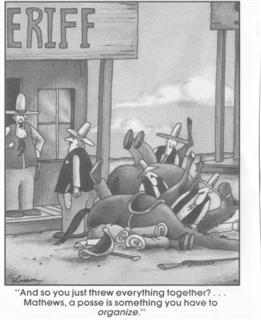
With all these options to choose from, how do you go about making the choice? It’s best to take professional advice on the best way to set up your business. You will need to think very carefully, for example, about how your business relationship will work in practice before you go into partnership, or about your personal circumstances and attitude to risk before settling for being a Sole Trader. It’s easy to assume that you need to form a Company, but this is not always the appropriate solution. At CMC we can provide you with the right advice to facilitate your decision, as well as pointing you to the right sources of specialist help from solicitors, accountants etc. And finally, when circumstances change, consider if your structure is still the right one – you don't have to stick with the structure you chose when you started up! Or you could take the advice of the Far Side:
How I Changed the Legal Structure of My BusinessSamantha Hale has run her sports-products business, Advance Performance UK, as a sole-trading operation, a partnership and a limited company. Founded in 1996, the company first traded from a back bedroom but now has its own shop and is growing at a rate of over 20 per cent a year. She explains: "When I started I was selling sports products and my then-husband was coaching athletes. I started small, operating from home, and never needed outside funding, so being a sole trader seemed the simplest option. But when I decided to get retail premises, things grew quickly and the expense of stocking and marketing the shop meant a strain on cashflow. So, a few months into having the shop, my husband and I formed a partnership. That way we could offset the initial 'start-up' losses from the shop against the profits from the coaching side of the business. I had to notify HM Revenue & Customs but I was able to retain my VAT number which made things easier administratively. When my marriage and business partnership collapsed I immediately changed the business to a limited company so I could protect my personal assets. There are two people who really make this business run now, myself and the company secretary. He's worked his socks off since the shop opened, so going incorporated allowed me to give him 20 per cent of the company's shares as a reward for his commitment." (from www.businesslink.gov.uk ) |

|
You have received this issue of our newsletter because you requested it or I thought you would find it useful. If you would rather not receive any more issues, please follow this link. If this issue of Six Degrees has been forwarded to you and you would like to receive regular issues, please follow this link. |
 |
