Dear Chantal

Seeing opportunities and bringing solutions (adding value), are the key to the success of your salespeople.  In a team of self-directed individuals, this requires a high degree of self discovery.

This month’s REACH! from amplia suggests ways to help you facilitate self-discovery within your teams. By definition, self-discovery is the “degree to which individuals possess the capacity to break through and comprehend an entire situation”.  The more self-discovery an individual possesses, the less he/she relies on others for direction and guidance; he/she finds his/her own solutions.

But do all your people know how to use this vital skill? And why is it so important to develop self-discovery within your team?

Typically, a person with a high degree of self-discovery is someone with their own ideas and initiative. This person possesses an “open” mind to what can happen; they “look beyond” and see opportunities as challenges to be addressed. The greater the level of self-discovery individuals have, the greater their understanding and, ultimately, commitment will be to the solutions, or actions, needed to improve performance. It becomes a person’s own commitment to see his/her own solutions through. This means individuals become more self-directed and committed to achieving the desired outcome. Importantly, this leads to increased personal accountability for performance.

Best wishes,

Trese Rowe

Reaching Your Potential – Believe in People

It is often said that before you can help someone you need to believe in them first. In this instance, a manager can introduce processes and systems to a team, but if he/she does not have faith in his/her team’s ability, these things will not work. High-performance organisations are comprised of people who believe in the importance of understanding people and working together to achieve an end result.

So how does this apply to facilitating self-discovery? Like many other things, you can influence and develop this quality in your people through effective interactions. Begin with the belief that each individual has a high degree of self-discovery. Your starting position should be that their ideas are important.

Ask broad open questions to encourage individuals to think about the situation they face.  You want them to discover their own solutions. Listen to their responses and from these you can build on the types of questions you ask to develop their self-discovery. Keep in mind the desired outcome: a commitment to an effective course of action.

Reaching Out – Facilitating Self-Discovery

To encourage an individual to develop independent thinking, a manager needs to have a strategy to base his/her interactions on.
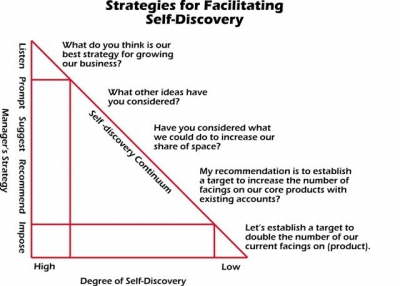
Begin by asking an open question about the subject for discussion, then listen to the answer e.g. “What do you think is our best strategy for growing the business ..?”

Perhaps he/she requires more coaching to be able to identify an answer? Prompt him/her with a question like, “What other ideas have you considered ..?”

Then you can “feed” the individual by making them think further, and suggest, e.g. “Have you considered what we could do to increase our share of space ..?”

If you are still not getting the kind of responses you are looking for, recommend a solution, “my recommendation is to increase the number of facings on our core products with existing accounts…”

In adopting this approach you are coaching the individual; you are ‘teasing’ out a suggestion or idea.  As you move through this process, you will find that some individuals respond with what you are looking for. However, there will be some individuals who require more coaching.  Be patient, be creative with your questioning and remember the basic strategy for facilitating self-discovery; listen- prompt-suggest-recommend. As a last resort, you may have to impose a solution or action, e.g. “Let’s establish a target to double the number of facings on (product)”. Why is this the worst case scenario?  Because before you impose a goal and dampen an individual’s enthusiasm, you should consider how committed he/she is to your idea compared to how committed he/she is to his/her own idea. We call this the “100% idea”; your perfect solution for improving performance.
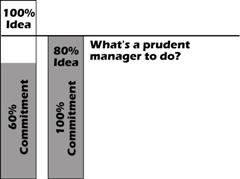
So you have a 100% idea, but the individual doesn’t agree and he/she has another idea. You don’t see his/her idea as being as good as yours; you think it is an 80% idea. We say the individual is 100% committed to his/her idea but only 60% to yours.

Your idea is great but by questioning and listening to your salesperson, in other words, facilitating their self-discovery, you may ‘win’ him/her over.  On the other hand, facilitating self-discovery is not a one-way process; you may just learn that you don’t always come up with the best ideas!

So whose idea is it to be? A prudent manager will go where the commitment is (as long as the individual’s idea isn’t just a 10% idea!).  The most effective leaders are those who demonstrate their trust in their people so, when individuals come up with their own ideas, be prepared to accept them.

Reach Resources

Our recommended reading list for more information on facilitating self-discovery:

It's Not How Good You Are, It's How Good You Want to Be by Paul Arden is a handbook of how to succeed in the world - a pocket "bible" for the talented and timid to help make the unthinkable and the impossible possible.

The One Minute Manager by Ken Blanchard provides you with simple methods on how to get the best out of your people.

7 Habits of Highly Effective People by Stephen R. Covey provides us with principles that give us the security to adapt to change, and the wisdom and power to take advantage of the opportunities that change creates.

The One Minute Manager Builds High Performance Teams  by Kenneth H. Blanchard, Donald Carew, Eunice Parisi-Carew is an alternative way towards better team-building and shows how any team can work better and more effectively, by tapping into the creativity and potential of people at all levels.

In our May issue we will look at how to build the momentum that is a powerful characteristic of all high-performance organisations.

amplia Consulting Ltd
Rosewood House
The Coombe
Streatley-on-Thames
Berkshire
RG8 9QT
Tel: 01491 871 203
E-mail: trowe@amplia.co.uk

You are receiving this email because you are a friend or client of amplia or you have requested the newsletter from us. If you no longer wish to receive this please click here.
[[edit_details]]